Research and Writing
Research Methods
When choosing a research method, the most important starting point is your research question. Your question should show what kind of answer you are looking for—for example, “how many?” versus “how?” If your question is about measuring, testing, or evaluating relationships using numbers, a quantitative approach is usually best. If you want to explore experiences, meanings, or processes in depth, a qualitative approach will be more suitable.
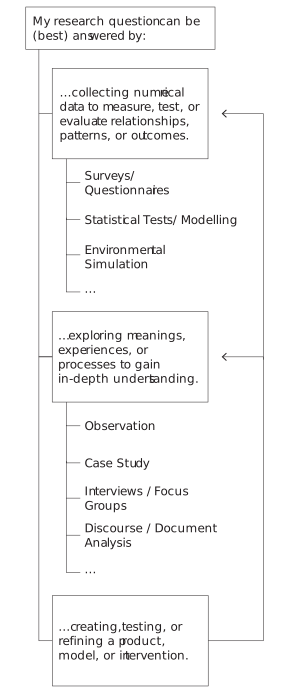
Design-based research involves creating, testing, or refining a product, model, or intervention. However, it is also important to collect some form of evaluative data at the end.This could be a reflection, feedback from users, or results from a simulation to show what worked, what did not, and why.
Once you know whether your project is primarily quantitative, qualitative, or design-based, you can choose a specific method within that category. Quantitative methods include surveys, experiments, or statistical analysis. Qualitative methods might involve interviews, focus groups, case studies, observations, or analysing documents and conversations.
Sometimes, more than one method could work for your question. When that happens, it is important to think about what is realistic. Consider how much time you have, what skills you already have (or are willing to learn), and what resources are available, like access to participants, data, or special equipment. A method that looks perfect in theory might be too ambitious in practice, so it is important to balance your goals with what is achievable.
Finally, remember that you will need to justify your choice in your dissertation. It is not enough to simply state which method you are using; you should also explain why it is the most appropriate option and how it helps you achieve your research aims more effectively than the alternatives. Showing this awareness strengthens your work and demonstrates that your project is well designed.
Diagrammatic Analysis of Buildings
It is possible to distinguish between two complementary approaches to the analysis of buildings: diagrammatic analysis and formal analysis.
Diagrammatic analysis is concerned with the relationships among the parts of a building. It investigates how spaces connect, how hierarchies are established, and how organisational structures emerge. By focusing on these relationships, diagrammatic analysis opens the possibility of linking architecture to broader concerns such as economy, use, perception, and experience.
Formal analysis, by contrast, is oriented toward architecture as an autonomous discipline. It focuses on geometry, proportion, structure, and the underlying compositional logics of form. Together, these two modes of analysis provide a fuller picture of architectural thought.
Diagrams are an essential tool in the analysis of architectural precedents because they distil complex buildings into their essential characteristics and relationships. Unlike photographs or fully detailed drawings, diagrams simplify and abstract information, making it easier to identify patterns, hierarchies, and functional arrangements.
This abstraction is particularly valuable when comparing buildings of different styles, periods, or scales. Through diagrammatic analysis, it becomes possible to reveal underlying strategies and design principles that transcend formal differences.
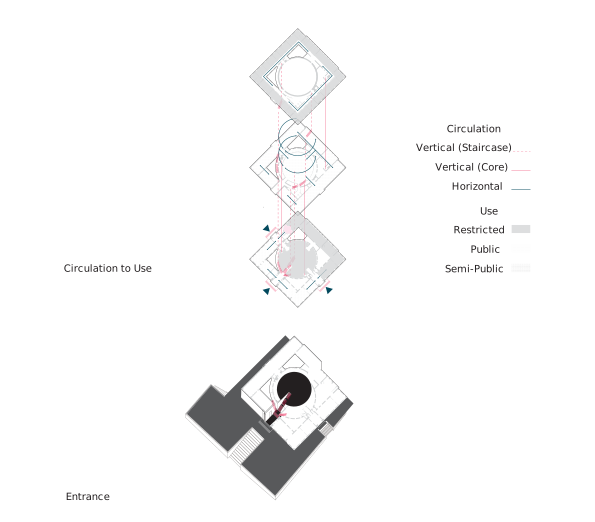
Several examples of diagrammatic approaches can be used depending on the research question, e.g. distribution, programme, part-to-whole, plan types, structure... The example below is the Circulation to Use diagram of the Stockholm Public Library (1928, Gunnar Asplund), showing how people move through a building and where that movement intersects with zones of use.
Bibliography
Clark, Roger H., and Michael Pause. 2005. Precedents in Architecture: Analytical Diagrams, Formative Ideas and Partis. London: John Wiley & Sons.
Jacoby, Sam. 2016. Drawing Architecture and the Urban. Chichester, UK: Wiley.
Formal Analysis of Buildings
Formal analysis is oriented toward architecture as an autonomous discipline. While diagrammatic analysis investigates relationships and use, formal analysis focuses on the physical and visual characteristics of a building itself. It considers geometry, proportion, structure, and the underlying compositional logics of form.
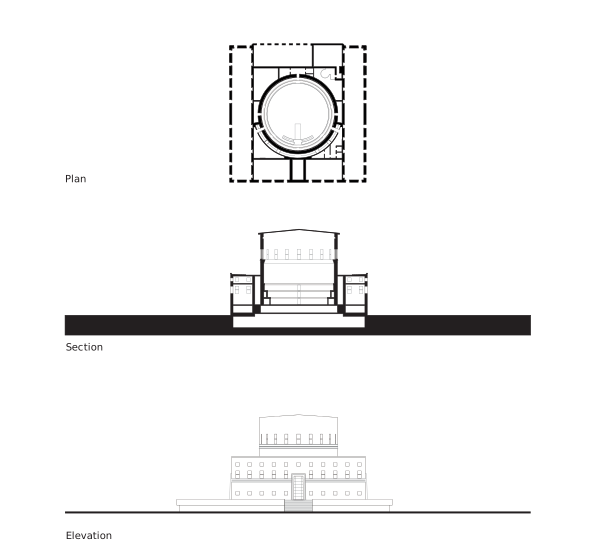
The starting point for formal analysis is often the plan, section, and elevation, which reveal how form is organised in two and three dimensions. From these, attention may be directed toward broader formal qualities such as massing, i.e. 'the perceptually dominant three-dimensional configuration of a building' (Clark & Pause), geometry, symmetry and balance, proportion and scale, or the structure. The example below is the massing diagram of the Stockholm Public Library (1928, Gunnar Asplund).
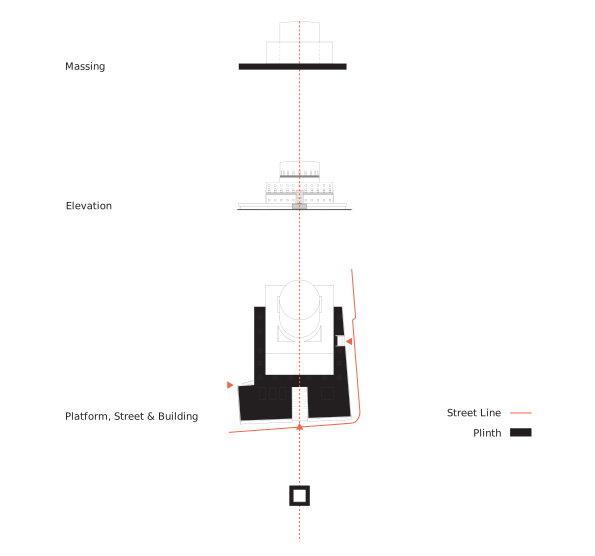
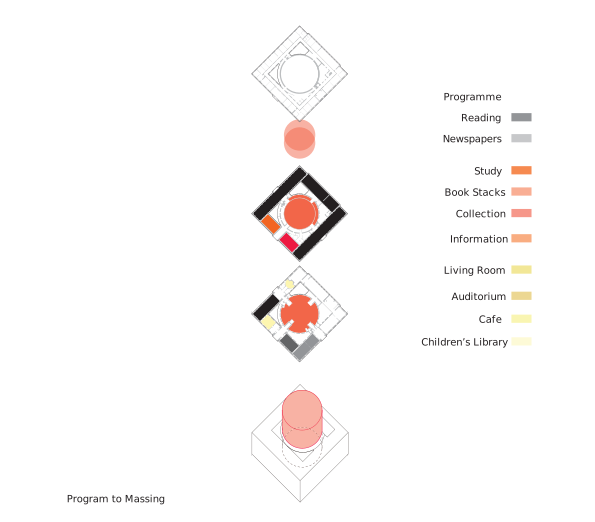
Formal analysis highlights architecture’s aesthetic and disciplinary dimensions.. It is interested in buildings as objects with their own internal logic. When combined with diagrammatic analysis, it allows a fuller understanding of both how a building works and how it communicates as a piece of architectural form. The example below juxtaposes the massing diagram of the Stockholm Public Library (1928, Gunnar Asplund) with its programme diagram.
Bibliography
Eisenman, Peter. 2008. Ten Canonical Buildings, 1950–2000. New York: Rizzoli International Publications.
Descriptive, Analytical and Critical Writing
Architectural writing can take several forms depending on the purpose of the text. In academic essays and dissertations, it is important to distinguish between descriptive, analytical, and critical writing. Each has a different function, and effective writing often requires a combination of all three.
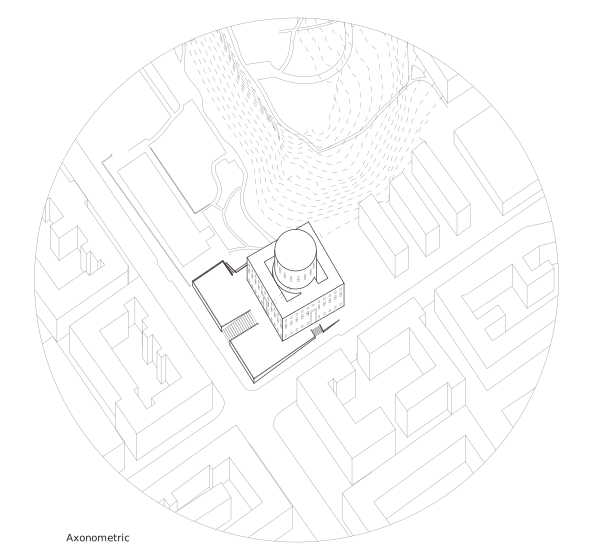
Descriptive writing is the most basic form. It records and communicates what is there, establishing a factual foundation. When engaging with buildings, this often involves explaining what it looks like, how it is organised, what materials it uses, or when and where it was built. A descriptive account of Gunnar Asplund’s Stockholm Public Library (1928), for example, might note that the building is organised around a central rotunda with three rectangular wings, and that visitors enter through a low, linear hall before ascending into the main reading space. Such description is necessary because it provides the reader with a clear picture of the building under discussion.
Analytical writing goes further. Rather than simply describing what is present, it asks how the building works and what relationships can be observed within it. Analysis reveals connections, patterns, and strategies: circulation routes, hierarchies of space, structural organisation, or the interplay of material and form. In this way, it works with the diagrammatic analyses. Returning to the example of the library, an analytical passage might suggest that the sequence from the compressed entrance to the expansive rotunda heightens the impact of the main reading space, or that the rotunda serves as the symbolic centre of knowledge with its disposition at the centre.
Critical writing represents the most advanced stage. It does not only describe and analyse, but also evaluates, compares, and takes a position. Critical writing situates a building within broader debates and allows the writer to demonstrate independent thought. It might involve questioning assumptions, weighing competing interpretations, or connecting architectural form to social and cultural contexts. For instance, one might read Asplund’s library as reinterpreting the temple within the secular city.
In practice, strong architectural writing often combines all three modes. Description establishes clarity, analysis deepens understanding, and criticism develops interpretation into argument. Students should aim to move fluidly between them, beginning with a clear descriptive base, then drawing out relationships through analysis, and finally stepping back to develop a critical perspective that situates the building in its wider cultural and intellectual context.